
Author
B. Marco Guarneri is an Italian writer and essayist. His inquiry is born from the meeting of lived experience, the study of conditioning, and symbolic imagination. In the first book it takes the form of the essay; in the work that follows it enters fiction.
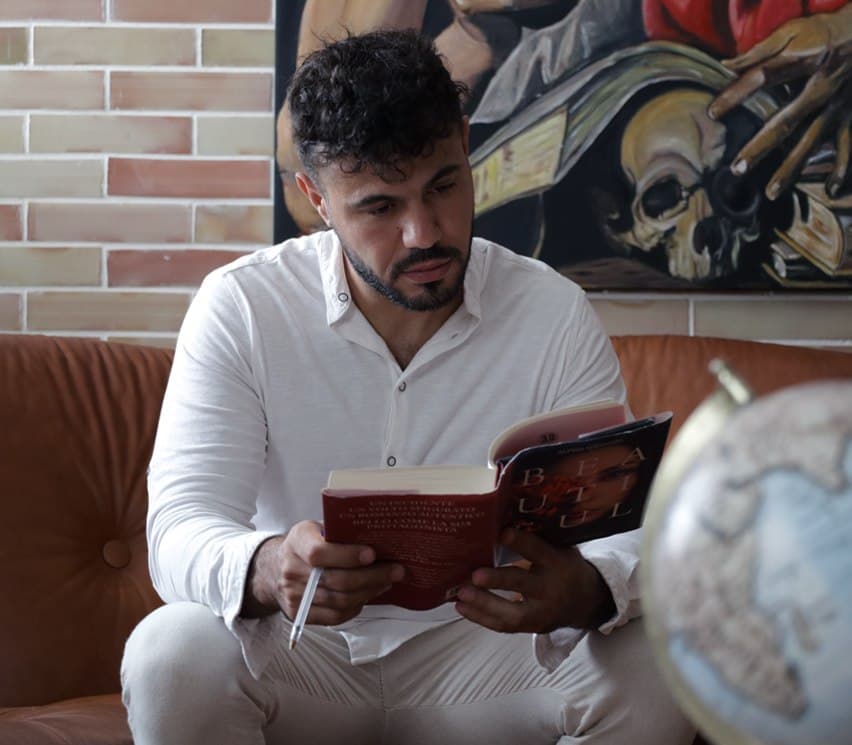
Biography
B. Marco Guarneri, the pen name of Biagio Marco Guarneri, was born on 25 February 1990 in San Cataldo, in the province of Caltanissetta. He lives and writes in Sicily with his wife and their three children.
Sicily—with its countryside, sea, woods, parks, Mediterranean greenery, Mount Etna and the heat that dries the land—belongs to his daily experience and has entered the landscape of his works. Walking gives him a rhythm of observation; writing gathers what that movement brings to the surface.
The desire to write goes back to childhood. Before he knew words, he imagined a book for Gerry, a small companion kept in memory.
Between his second and third years of middle school, he went through roughly a year of medical appointments, hospital visits and treatment following a diagnosis of a parotid tumour that was later found to be incorrect. That experience, reworked many years later in «Il Giardino Invisibile», made the urge to write more insistent.
In 2009, the year he completed high school and his first daughter was born, he did not immediately continue his studies, devoting himself to family and work. That same year he entrusted thoughts and verses to a yellow diary, later transcribed into the unpublished file «Tutto quello che vorrei».
Among those texts he particularly remembers «Fare ed Essere, due fratelli inseparabili», an early trace of the tension between being and doing that would later run through his inquiry into dispersion. In the following years he continued to carry notebooks with him and, after work shifts, often wrote at night facing the sea.
In the years that followed, his inquiry also turned toward religion and spirituality. A journey to the sites of Qumran and his later departure from a spiritual environment whose sectarian nature he gradually recognized strengthened his interest in the gap between words and the substance they claim to preserve.
Working alongside older people with neurodegenerative illnesses brought questions of memory, identity, fragility and time to the foreground. During night shifts, reading became a spontaneous and continuous form of study.
As an adult he returned to university, graduated in Business Economics and pursued further study in communication and storytelling. This education also shaped his critical view of models of efficiency, performance and control when applied without measure to human life. His inquiry widened through psychology, neuroscience, philosophy and the analysis of social systems, gradually taking on an independent character.
In 2019 his writing took on a clearer direction: leaving his children something that could go beyond the role of father alone. Two unpublished texts took shape, «Lettera alla sfuggente sconfitta» and «Dialoghi con la Piccola Voce Amica».
On 3 January 2025, during walks in the Parco Dubini in Caltanissetta, he began recording and transcribing reflections, images and inner dialogues. The «Riflessioni al parco», an unpublished archive of over nine hundred pages, became the ground from which the world of Il Giardino Invisibile emerged.
In 2026 Davide Falletta Editore published «Il Giardino Invisibile» – Come coltivare la coscienza nell'epoca della dispersione. The book organized the first complete form of the inquiry and was later published in Spanish by DIEFFE Publishing.
The choice of Spanish stems from a personal connection with Spain and the Spanish-speaking world, which the author regards as a second emotional geography. The Spanish edition «El Jardín Invisible» begins this linguistic and cultural dialogue.
The same inquiry continues in fiction.
Writing as inquiry
The starting point is a concrete question: how much of identity is born from choice, and how much is absorbed from the environments in which we grow up? Family, school, work, language, technology and society appear in the books as forces that also inhabit the mind and behaviour.
«Il Giardino Invisibile» addresses these forces directly, weaving together personal episodes, interdisciplinary references and symbolic images.
Poetics
The symbol is born from the friction between an experience and a question. Before becoming an idea, it has a body: an acorn, a pot, a parched expanse, an animal rising into flight. The page keeps that concreteness and lets thought emerge from the movement of the image.
Unity and separation run through the whole inquiry. The works follow this tension in gestures, relationships and collective forms, leaving readers their own space of judgment.
Readings and resonances
The author's library includes philosophy, psychology, myth, neuroscience and narrative fiction. Socrates, Carl Gustav Jung, James Hillman and Joseph Campbell are important references for the question, the symbol, the vocation and the structure of the journey. The works cite and discuss many other authors; the complete bibliography belongs to the books, not to the author's public presentation.
Themes of the work
Consciousness and dispersion
Identity and conditioning
Childhood and memory
Individual and social systems
Destiny and responsibility
Symbol and transformation
Unity and separation
From the book
This book is born from a stubborn inquiry, from falls and returns, from questions that opened other questions.